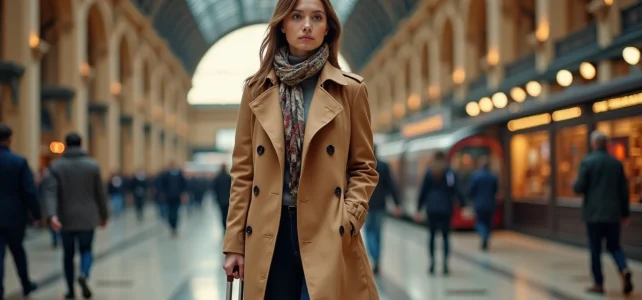
Comparing travel clothing approaches is akin to measuring the gap between what social media values and what actually works on a long-haul journey. The “airport outfit” trends promoted by TikTok and Instagram since 2022 have redefined visual expectations, while the quiet luxury movement pushes towards more understated and sustainable choices. This article analyzes the concrete criteria that separate an effective travel style from mere photographic staging.
Quiet luxury vs. airport outfit: two travel clothing logics
These two currents have dominated travel fashion since 2023, but their foundations diverge on several axes. The table below summarizes the structural differences between these approaches.
| Criterion | Quiet luxury | Airport outfit (TikTok) |
|---|---|---|
| Palette | Neutral colors, muted tones | Coordinated sets, bright or pastel colors |
| Logos | Absent or very discreet | Visible, identifiable in photos |
| Materials | Cashmere, merino wool, thick cotton | Synthetic knits, technical joggers |
| Durability | Pieces designed to last several seasons | Quick rotation, visual obsolescence |
| Main audience | Business/first travelers, ages 30-55 | Ages 18-34, strong social media presence |
| Objective | Discreet comfort, versatility | Immediate visual impact, “photogenicity” |
The Virtuoso 2024 and American Express Travel 2023 reports document the rise of quiet luxury among premium passengers on Europe-North America routes. High-income travelers prefer discreet, comfortable, and durable silhouettes over the logo-mania that dominated the 2010s.
In contrast, the Booking.com 2023 travel forecast study notes that young travelers adjust their outfits to look good in photos or videos. The “Pack with me” formats have made coordinated sets and visible accessories (hats, headphones) almost mandatory in this age group.
The media Globe Modeuse regularly analyzes this tension between sustainable elegance and style calibrated for social media, offering useful benchmarks to arbitrate between these two logics before each departure.

Elegant travel suitcase: pieces that work everywhere
The real difference between a stylish traveler and a cluttered one rarely lies in the number of clothes. It lies in the compatibility between the pieces packed. A high-performing travel garment meets three simultaneous constraints: it wrinkles little, can be worn in at least two different contexts (day and evening), and dries quickly.
- A straight-cut technical fabric pant replaces raw denim on long flights: lighter, less constraining in a seated position, and dressy enough for a restaurant upon arrival
- A merino or dense cotton shirt regulates cabin temperature and remains presentable after several hours of wear, unlike fine synthetic materials that show marks quickly
- An unlined jacket, such as a deconstructed blazer or thick overshirt, serves both as an intermediate layer on the plane and as an outer piece in temperate climates
- Soft leather or suede flat shoes pass through security easily and are suitable for both urban walking and a dinner
The goal is not to multiply outfits but to reduce the number of pieces while increasing possible combinations. Three bottoms and four well-chosen tops cover a full week without visible repetition.
Travel accessories and style: what really changes comfort
Accessories often highlight the most significant gap between appearance and functionality. An oversized travel bag imposes a slow pace of movement and an unbalanced posture. A bag that is too small forces the need for multiple additional pieces of luggage.
The rigid cabin format remains the most versatile for short and medium trips. Its structure protects clothes from wrinkles and facilitates internal organization by compartments. For longer stays, a soft bag with a semi-rigid frame offers a better weight-volume compromise.

The integration of sustainability criteria in accessory choices is progressing rapidly. The Global Sustainable Travel 2024 report from Booking.com indicates that the majority of travelers express a desire to travel more sustainably. This intention is concretely reflected in a growing demand for luggage made from recycled materials, refillable toiletry bags, and technical clothing made from recycled fibers.
Dual-function accessories
A silk or modal scarf protects against the cold in the cabin, serves as a spare blanket, and adds a stylish element to a neutral outfit. An interchangeable leather belt (removable buckle) transitions from casual to dressy without taking up extra space in the suitcase.
Noise-canceling headphones have become a full-fledged style accessory according to Booking.com 2023 data: young travelers consider them a visible element of their outfit, on par with a watch or sunglasses.
Sustainability and travel elegance: the ongoing convergence
The rise of quiet luxury and the demand for sustainability are not parallel phenomena. They converge towards the same result: more streamlined travel wardrobes, composed of higher-quality pieces, worn longer.
- Brands positioned in the “sustainable travel clothing” segment now incorporate recycled fibers into tailored cuts that do not resemble technical outdoor wear
- Textile certification labels (GOTS, OEKO-TEX) are increasingly appearing on urban-oriented pieces and not just on sports items
- The second-hand market for high-end travel pieces (luggage, garments made from noble materials) is growing, driven by specialized resale platforms
This convergence alters the very definition of “travel style.” Elegance is now also measured by the footprint left by the wardrobe, not just its visual rendering. The most image-conscious travelers incorporate this parameter into their choices, including on social media where “responsible fashion in travel” content is gaining visibility.
The gap between the two dominant approaches (quiet luxury and airport outfit) is gradually narrowing on the sustainability criterion. The most enduring travel style combines versatile pieces, durable materials, and a limited palette that ages without going out of style.