Replacing a front door involves much more than just choosing a model. The thermal coefficient Ud, resistance to break-in, the sealing of the threshold, and compatibility with the existing frame all determine the final result. A poorly installed high-performance door can allow air to pass through the junction between the frame and masonry, negating the expected insulation gains. Here are the technical points to master before and during installation.
Coefficient Ud and threshold sealing: two often overlooked angles
Most guides detail the steps for fixing the frame without addressing the actual performance of the door unit once installed. The Ud coefficient concerns the door as a whole, not just the panel. Checking this value in the manufacturer’s documentation for the specific reference ordered helps avoid disappointments.
In renovations, a door leading to the outside must meet the thermal requirements applicable to element-based work, according to the amended decree of May 3, 2007. In practical terms, a well-insulated panel is not enough if the frame or threshold creates a thermal bridge.
Sealing defects often concentrate at the bottom of the door, at the junction between the frame and the masonry, and in the closing areas. A poorly treated threshold or poorly compressed seals allow air and water to pass through, even with a high-end model. Before any installation, it is essential to assess the condition of the floor, the flatness of the existing threshold, and the quality of the planned peripheral seals.
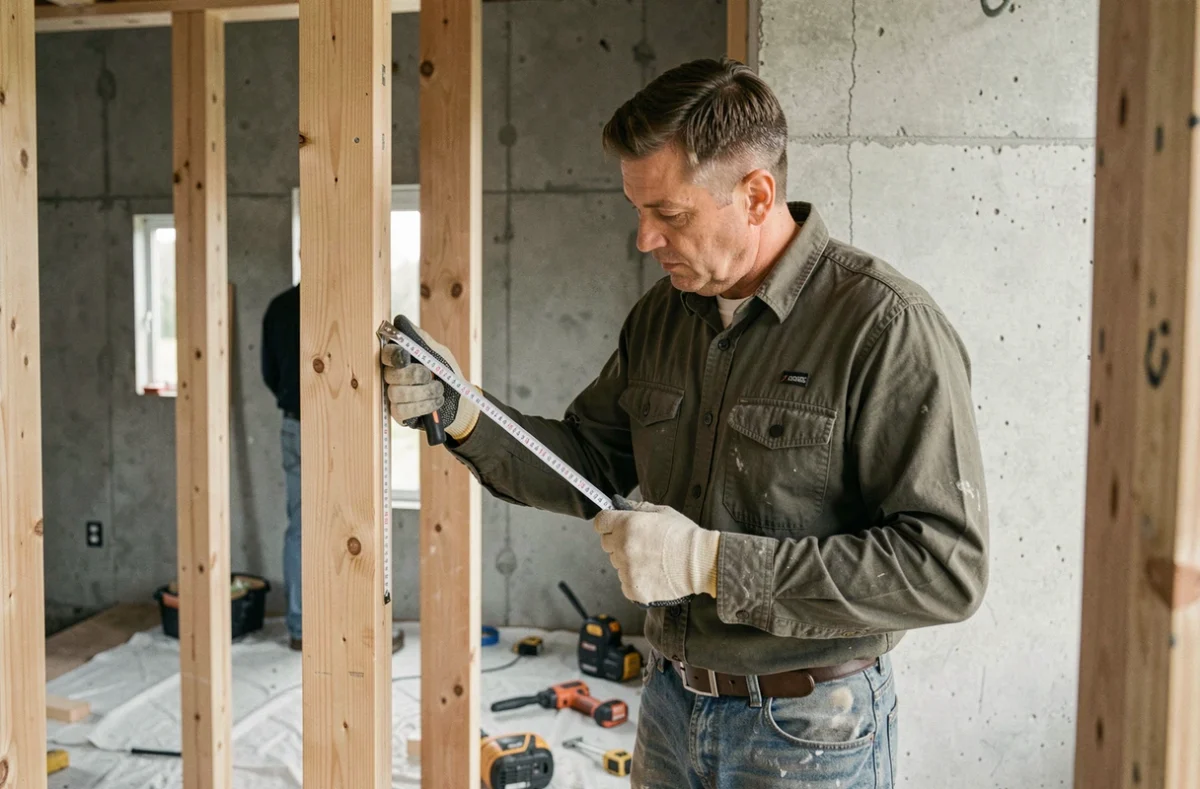
Successfully installing a front door requires careful preparation of the opening, particularly the regularity of the masonry frame and the plumb of the uprights.
Renovation installation or total removal: technical choice criteria
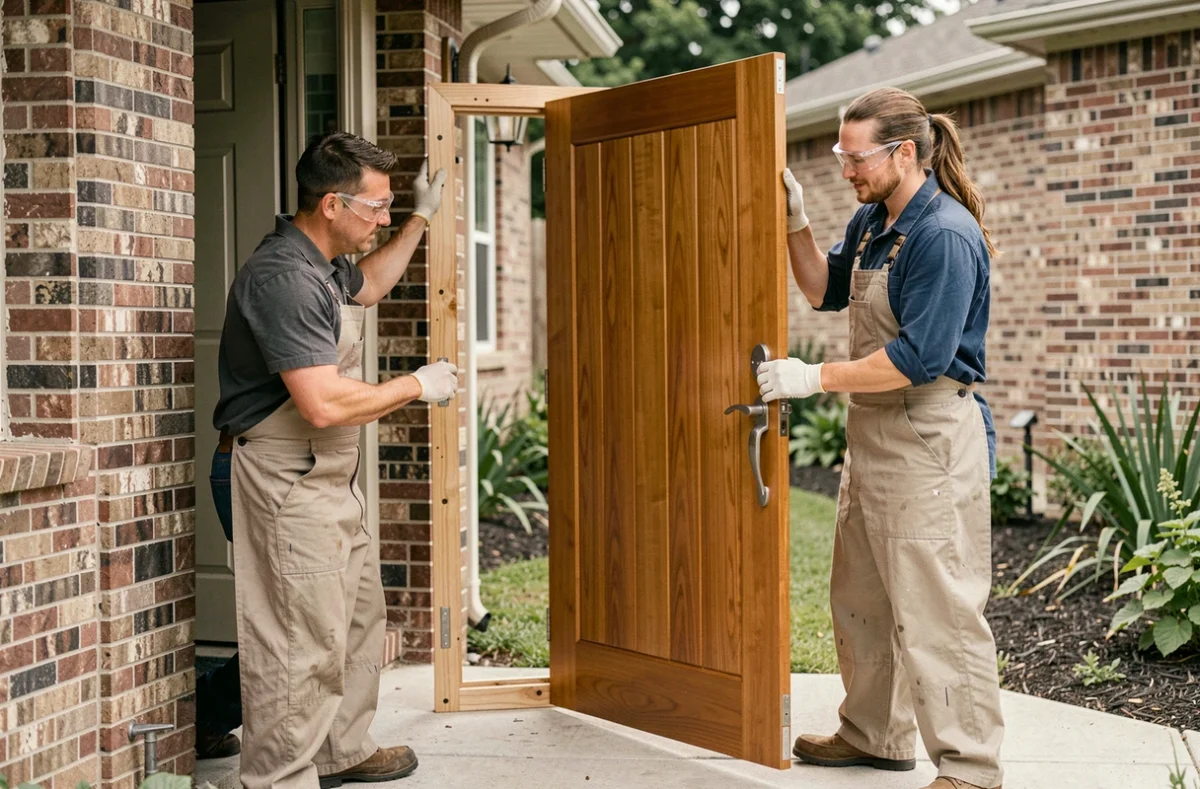
Two methods exist, regardless of the material (wood, aluminum, PVC). The choice depends on the condition of the existing frame, not on a comfort preference.
When renovation on the existing frame holds up
Renovation installation retains the old frame. It is quicker and limits finishing work on the wall. This option is only viable if the frame is sound, without rot, deformation, or excessive play. A wood frame swollen by moisture or a corroded metal frame compromises the plumb and sealing of the new door.
Check the squareness of the frame with a level and a carpenter’s square. A few millimeters of diagonal discrepancy is enough to create friction or visible gaps once the leaf is installed.
When total removal is necessary
If the frame is damaged, out of square, or too old to ensure good insulation, total removal replaces both the frame and the door. This method requires peripheral masonry work: re-plastering, installing stops, and wall connections. The result is more durable, but the project takes an additional day and requires skills in carpentry and masonry.
- Sound frame, correct squareness, no signs of moisture: renovation installation is suitable.
- Deformed frame, rotten wood, or oxidized metal frame: total removal is the only reliable option.
- Switching from one material to another (wood to aluminum, for example): total removal allows for adapting the dimensions and threshold to the new door unit.
Anti-burglary security: what the lock alone does not guarantee
A multi-point lock does not protect anything if the frame gives way under a crowbar. The resistance to break-in depends on the entire installation, not on an isolated component. The frame, hinges, any glazing, and the locking system form a whole.
Certifications (A2P for the lock, for example) apply to specific installation conditions. A certified lock installed on a fragile frame or with screws that are too short loses its level of resistance. During installation, the fixing points of the frame in the masonry must be sized to withstand pulling, not just to hold the frame in place.
Anchoring the frame with fixing brackets suitable for the type of wall (expansion plugs for concrete, chemical anchoring for hollow blocks) is part of the actions that separate a secure installation from a simply functional one.

Financial assistance for a front door: a point to check on a case-by-case basis
Contrary to what some retailers suggest, there is no MaPrimeRénov’ grant “per action” for the isolated replacement of a front door. Its consideration may depend on a global renovation pathway, where the door is part of a bundle of work including other insulation or heating items.
Programs and conditions evolve regularly. Before placing an order, checking eligibility directly with official sources remains the only reliable approach. Commercial information on manufacturers’ websites does not replace consulting the France Rénov’ simulator at the precise moment of submission.
Finishes and checks after installing the front door unit
Once the frame is sealed and the leaf is hung, several checks determine the actual quality of the installation:
- Closing and opening without friction or abnormal resistance, leaf stable in the open position at 90 degrees.
- Uniform compression of seals around the entire perimeter, verifiable by sliding a sheet of paper between the leaf and the frame (the sheet should offer the same resistance on each side).
- Sealing of the threshold tested with a light stream of water from the outside to detect any potential infiltration.
- Correct operation of all locking points, including the top and bottom points often forgotten during the initial adjustment.
The joints between the frame and the wall are treated with sealant on the outside and expanding foam on the inside, ensuring not to deform the frame due to excessive expansion. A clean finishing joint in silicone or acrylic completes the visible covering.
The quality of a front door is judged by the silence it produces once closed. If a draft persists or if a gap is visible, the problem almost always comes from the threshold or a poorly compressed seal, rarely from the panel itself.