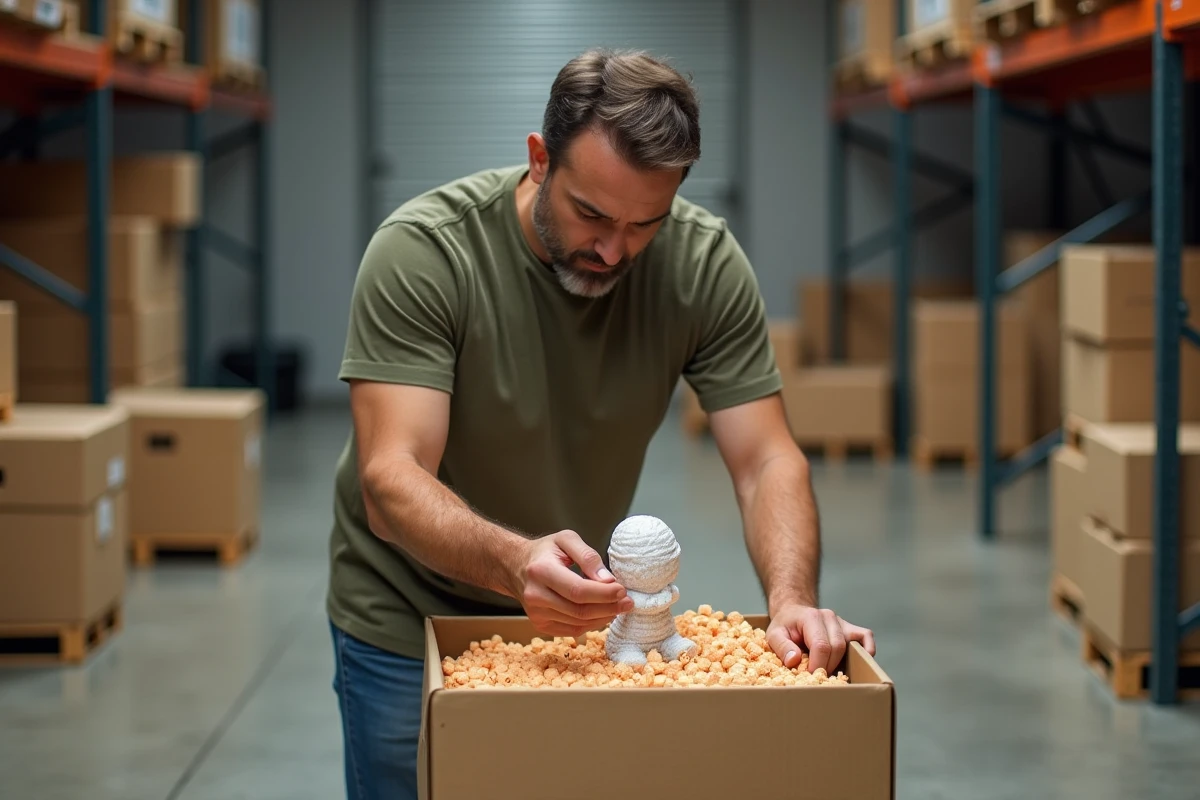
Packing a figurine for shipping means protecting an object whose fragility often relies on just a few millimeters of resin or metal. A spear, a fin, an outstretched arm: the points of breakage are numerous, and the journey through parcel relays or sorting centers is unforgiving. What packing and cushioning parameters truly reduce the risk of breakage during the transport of figurines?
Double packaging and cushioning: what carriers require for compensation
Since 2023, several carriers have tightened their general sales conditions regarding fragile or collectible items. Resin or metal figurines are explicitly mentioned: compensation in case of breakage requires double packaging with cushioning of at least five centimeters on each side.
The claim also requires photos of the packaging taken before shipping. Without this evidence, the claim is rejected. This level of documentation is rarely mentioned in general guides on fragile parcels.
Specifically, double packaging means a first box fitted around the figurine, which is then placed in a larger carton. The space between the two is filled with crumpled paper, foam, or bubble wrap. To delve deeper into this point, 100 000 Watts’ solutions detail the protective steps suitable for statuettes and sculptures.
| Criterion | Single packaging | Double packaging with cushioning |
|---|---|---|
| Protection thickness per side | Variable, often insufficient | Minimum five centimeters |
| Carrier compensation | Refused in most cases | Accepted subject to photos |
| Shock resistance in sorting center | Low (direct contact possible) | High (double wall + padding) |
| Preparation time | Several minutes | Longer, but cost-effective in case of dispute |
Pre-cut foam or bubble wrap: comparison for painted figurines
The wargaming market has popularized since 2022 cases with pre-cut foam or removable cubes, designed by manufacturers like Feldherr or KR Multicase. These solutions are widely recommended on hobbyist forums for painted figurines, especially those with fine elements (spears, banners, fins).
Bubble wrap remains the most accessible material. It absorbs shocks and adapts to any shape. However, bubble wrap can stick to acrylic paint if the figurine is not varnished or if contact lasts for several days during transport.
Pre-cut foam eliminates this risk: each figurine rests in a fitted slot, without friction. It is particularly suitable for repeated shipments or high-value pieces. The cost per unit is higher, but reuse compensates in the long run.
- Bubble wrap: economical, versatile, but should be interleaved with tissue paper to protect painted finishes.
- Foam with removable cubes: superior protection for pieces with protruding elements, reusable for regular shipments.
- Custom-cut foam: suitable for sculptures or atypically sized figurines, often used for unique pieces or limited editions.
Resin, metal, 3D printing: adapting packaging to the material of the figurine
Not all figurines react the same way to transport stresses. A heavy metal figurine withstands shocks better than a UV resin piece printed in 3D, whose layers can delaminate under the impact of a sudden blow.
Since the rise of UV resins between 2021 and 2024, temperature and humidity variations during transport weaken certain resins and paints. A figurine shipped in the middle of summer in a truck can suffer deformations if the resin has not been properly post-processed.
For resin or 3D printed figurines, a lightweight insulated packaging (bubble pouch lined with aluminum) limits thermal fluctuations. This detail is of no use for metal or injected plastic, but it makes a difference for fine resin pieces.
Fragile points to identify before packaging
Before packing, examine the figurine and identify vulnerable areas. A glued element (sword, shield, decorative base) will always be the first to give way.
- Glued or magnetized elements: disassemble if possible and pack separately in tissue paper.
- Thin parts (antennae, weapons, wings): individually wrap in bubble wrap before placing the figurine in its slot.
- Base or stand: cushion the base at the bottom of the box with foam to prevent the figurine from tipping during transport.
- Unvarnished paint: interleave a layer of tissue paper between the figurine and any material that may stick.

Sealing the parcel and labeling for shipping fragile figurines
The choice of the outer carton is as important as the internal cushioning. A single-wall carton is sufficient for small lightweight figurines. For heavy pieces or lots of several figurines, a double-wall carton reduces the risk of crushing in the sorting center.
Seal the parcel with wide tape on all joints, including vertical edges. Shake the parcel before sealing: if you hear or feel movement, add padding.
The “fragile” label has no contractual value with most carriers, but it guides manual sorting when it exists. Always take photos of the parcel open and closed before drop-off: this is the only admissible evidence in case of dispute.
The difference between a parcel that arrives intact and another that arrives in pieces rarely comes down to chance. It comes down to five centimeters of foam, a preventive disassembly of fragile parts, and a few photos taken before drop-off.