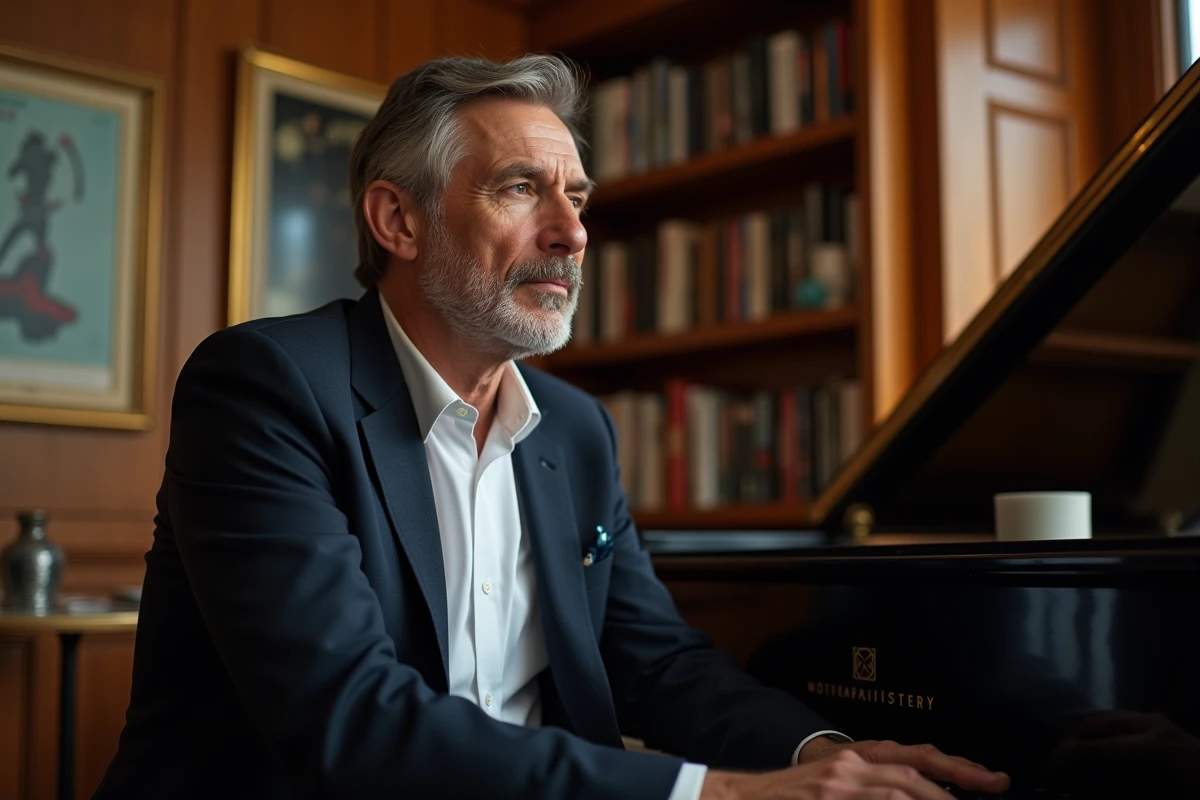
Philippe Jaroussky has never hidden his homosexuality. He has confirmed it in several interviews without making it a prolonged topic of discussion. What distinguishes his stance is the methodical locking down of everything concerning his relationship, in an environment where the boundary between stage persona and real life remains porous.
Couple Confidentiality and Norms of the Baroque Lyric Scene
The world of baroque opera operates on long tours, artistic residencies, and close collaborations between singers, instrumentalists, and conductors. Professional proximity pushes many artists to expose, willingly or not, their entourage. Jaroussky has taken the opposite approach.
His strategy relies on a strict separation between the media spaces he controls (promotional interviews, social media related to his recording projects) and those he refuses (tabloid press, home reports). No photographs of his partner have been published with his consent in specialized or general media.
This locking down is not trivial in French classical music. Other countertenors or openly homosexual lyric singers, particularly in the Anglo-Saxon repertoire, have made different choices by embracing marital visibility. Jaroussky is situated within a more French tradition of separation between the public and private spheres, akin to what some conductors or instrumental soloists practice.
To better understand the known elements about Philippe Jaroussky’s partner, one must accept that the artist has deliberately limited this information to a few scattered statements.

Philippe Jaroussky and the Question of Marriage: What the Interviews Reveal
Searches associating “Philippe Jaroussky” and “married” come up regularly. The artist has never publicly confirmed a civil marriage or an official union. The question has been posed to him several times, and his answers remain invariably evasive, without categorical denial or confirmation.
This maintained ambiguity is not accidental. It stems from a polished communication management. Jaroussky answers questions about his music with formidable precision (repertoire choices, vocal technique, historically informed interpretation), but as soon as the subject veers towards the personal, the tone changes: short sentences, a smile, redirection to the next project.
We observe this same pattern in other leading lyric artists who operate within the European festival circuit. The difference is that Jaroussky does it with a consistency that goes beyond mere modesty. It is a personal editorial policy.
Jaroussky’s Chosen Families: Academy, Orchestras, and Stage Partners
The countertenor has repeatedly described his collaborators as “chosen families.” This expression recurs in his interviews between 2017 and 2023, particularly when he speaks of the Jaroussky Academy or the Artaserse Ensemble he founded in 2002.
This shift is significant. Where the press expects sentimental confessions, Jaroussky offers an alternative narrative centered on:
- His role as a mentor to the young artists of his Academy, which he presents as an emotional as well as pedagogical commitment
- The bonds forged over several decades with his regular stage partners, described as relationships of trust that are almost familial
- The construction of a stable professional entourage that allows him to protect his intimate sphere without appearing closed off or distant
The Jaroussky Academy functions as a media substitute for the exposure of his romantic life. When a journalist seeks a human angle, the artist directs them toward this project, providing material for a warm portrait without conceding anything about his relationship.

Open Orientation and Protected Private Life: An Apparent Paradox
Publicly embracing his homosexuality while refusing to show his partner may seem contradictory. In reality, this stance is coherent and reveals a distinction that the public often confuses: identity visibility and relational visibility are two different things.
Jaroussky accepts being a recognized homosexual countertenor. He refuses to let this identity become a prism through which his discography or artistic choices are viewed. The nuance is precise, and it requires constant media discipline.
In the classical music world, this approach has concrete repercussions. Press agents, festival programmers, and record labels know that the subject is off-limits. Interviews are framed in advance. Photographers only have access to professional spaces (dressing rooms, stage, recording studios).
What This Says About the French Classical Scene
French classical music remains a sector where personal discretion is culturally valued. The most media-savvy conductors in France also protect their family life with comparable effectiveness. The field does not penalize discretion; it rewards it with a form of professional respect.
Jaroussky also benefits from the fact that his repertoire (baroque, early music, operas by Cavalli or Handel) attracts an audience that comes for the performance, not for personal storytelling. The demand for sentimental transparency mainly comes from the general press or online searches, rarely from the music-loving community itself.
- Specialized festivals never program intimate portraits in their communication materials
- Labels like Virgin Classics or Erato focus their promotion on repertoire and vocal technique
- Music critics respect a tacit convention of non-intrusion into the private sphere of soloists
The question “who is Philippe Jaroussky’s partner” will continue to generate searches. The answer will likely remain the same: an artist who has found a way to keep his private life truly private, in an era where this boundary is eroding for most public figures.