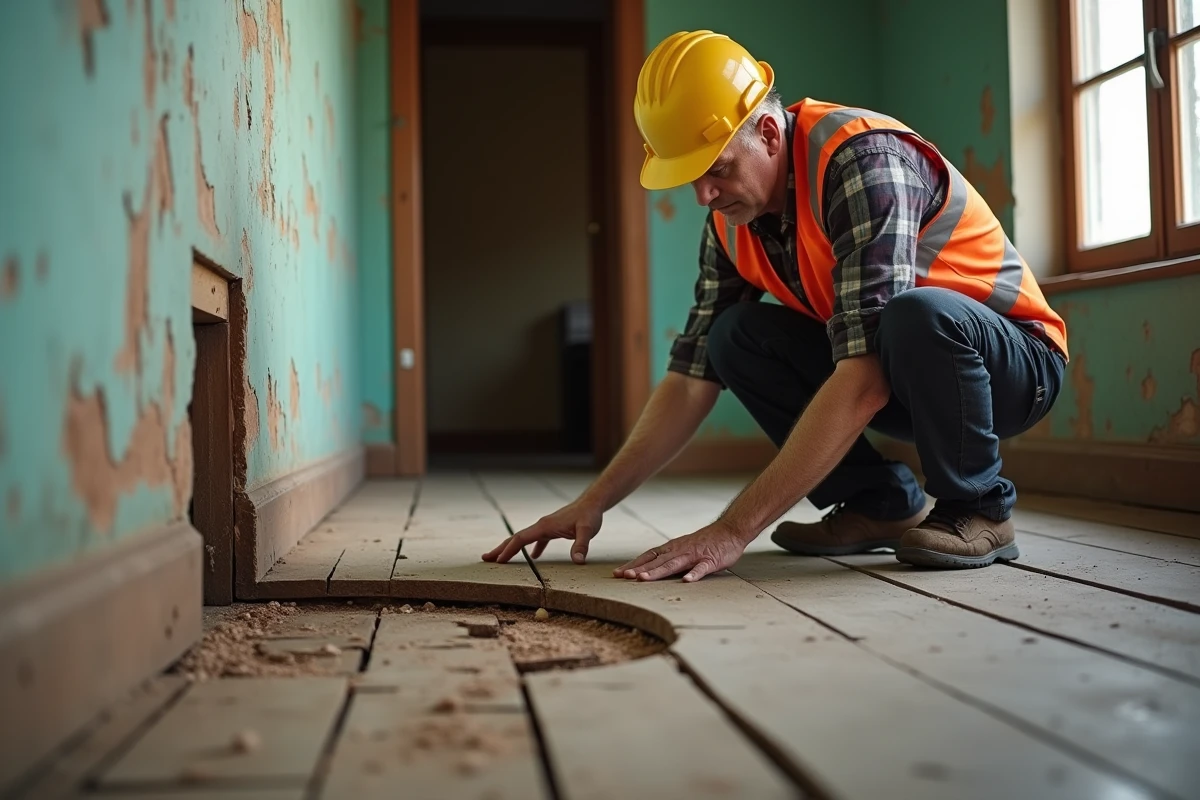
A floor that shows signs of structural fatigue does not always warn in a dramatic way. The distinction between a finishing disorder and a structural disorder determines the next steps, and we find that this understanding remains poorly mastered, even by some building professionals. Identifying the warning signs of a floor ready to collapse requires knowing what to observe, but also in what order to prioritize the alerts.
Bending under load and residual deformation of the floor
A wooden or concrete floor that bends under pedestrian load is not necessarily in danger. What should raise concern is the residual deformation after the load is removed. If the floor does not return to its initial position once the load is removed, the joists or slab have exceeded their elastic limit.
We recommend a simple laser level measurement over several days, placing fixed markers at the ends and the center of the span. An increasing deflection without the addition of permanent load indicates active creep, a sign that the load-bearing section is decreasing (rotting, corrosion of reinforcements, through cracking of the concrete).
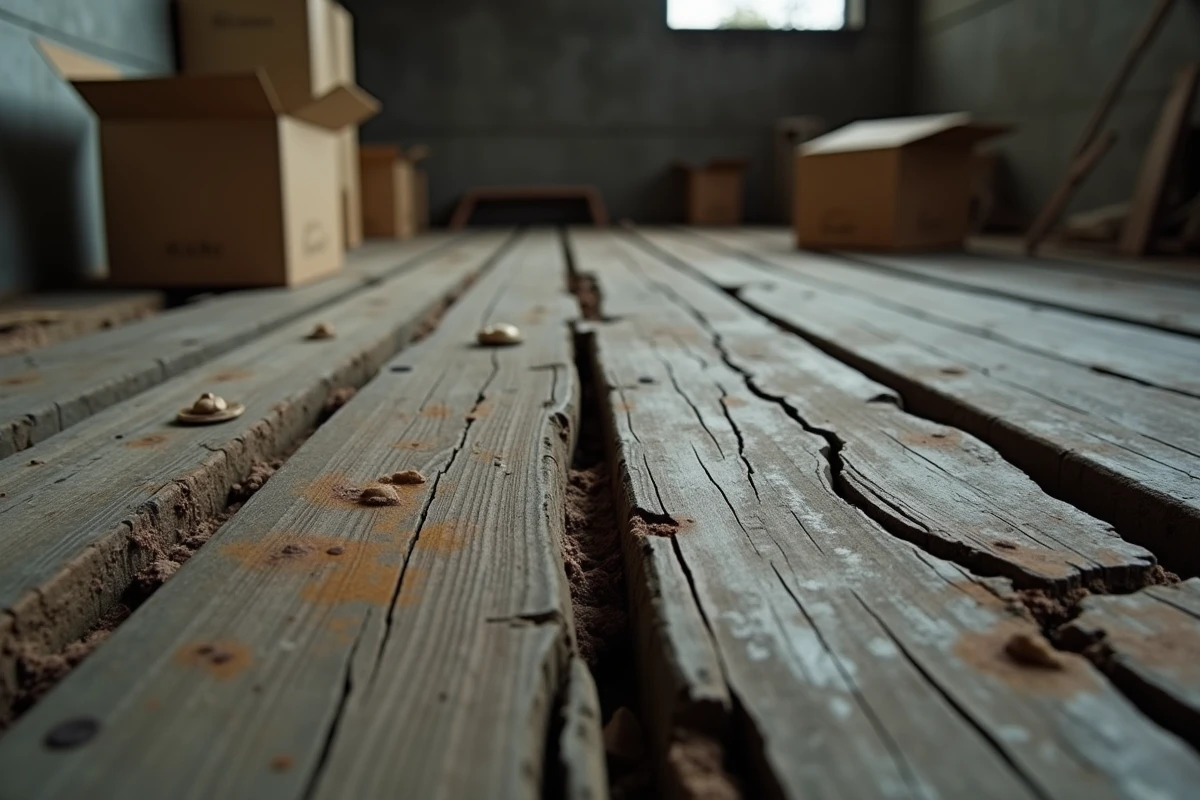
On a wooden floor, bending is often accompanied by creaking. An isolated creak is due to assembly play. In contrast, creaks that migrate from one area to another over a few weeks indicate a redistribution of forces, thus a localized loss of load-bearing capacity. This phenomenon regularly precedes the breakage of a joist or a blocking beam.
To delve deeper into this topic, the signs of imminent collapse of a floor according to Alpha Immobilier detail several mechanisms of gradual degradation to be aware of.
Cracks in concrete floors: reading the pattern and kinetics
Not all cracks are equal. On a reinforced concrete slab, we distinguish three families based on their orientation and evolution.
- Shrinkage cracks, fine and superficial, appear in the first months after pouring. They remain stable and do not compromise the structure. Their width rarely exceeds one-tenth of a millimeter.
- Bending cracks, perpendicular to the main reinforcements, open on the underside in the middle of the span. Their presence is normal to some extent, but a progressively widening crack over the weeks signals an overload or corrosion of the steel.
- Shear stress cracks, inclined at about 45 degrees near the supports, are the most critical. They indicate a risk of brittle failure, without significant prior deformation.
Kinetics matter as much as geometry. A crack meter placed across a crack allows for measuring its evolution over several weeks. A crack stable for years does not present the same urgency as a recently appeared crack that continues to open.
Indirect signs of a floor losing load-bearing capacity
The earliest manifestations of an impending collapse are not always found on the floor itself. The Clay Prevention Fund of the Ministry of Ecological Transition identifies several signs related to the movement of the support: localized bulging of the flooring, detachment of baseboards, doors that stick without apparent reason.
A tiled floor that detaches in patches in a specific area, while the rest of the covering holds, indicates a differential movement of the support underneath. This is not an adhesive problem. It is the floor that is shifting.
On wooden structures, the appearance of fine sawdust at the foot of load-bearing walls or under the joists signals an attack by wood-eating insects (woodborers, longhorn beetles). The load-bearing section of the wood piece can be significantly reduced while the outer surface remains intact. A probing test with a punch or hammer allows for verification: healthy wood produces a clear sound, degraded wood sounds hollow.

The case of shrink-swell clays
In areas exposed to the shrink-swell of clay soils, ground movements transmit stresses to the foundations, then to the lower floors. A floor on a crawl space can become cantilevered if the peripheral supports move differentially. Star-shaped cracks in the slab, centered on a load point (post, partition wall), are characteristic of this mechanism.
Structural expertise: when and how to initiate it
A visual diagnosis is not sufficient to qualify the level of risk. We believe that a structural expertise by a structural engineer is necessary as soon as at least two of the following signals coexist: progressive bending, inclined cracks near the supports, localized detachment of covering, or migratory creaks.
The expert conducts targeted destructive sampling (concrete coring, wood probing) and checks the residual load-bearing capacity through calculations. In a condominium, it is the property manager’s responsibility to mandate this expertise as soon as it is reported by an occupant. The property manager may be held liable for inaction in the face of reported disorders.
For old wooden floors (buildings predating the 1950s), the examination focuses primarily on the areas where the joists are embedded in the walls, where moisture concentrates. A joist may be healthy in its main section and completely degraded at its supports.
- Check the condition of the joist ends by probing from the basement or the lower false ceiling.
- Inspect for signs of moisture or fungi (notably dry rot) on the load-bearing walls at the level of the embeddings.
- Measure the moisture content of the wood with a pin moisture meter: beyond a certain threshold, the risk of active rot becomes significant.
Prevention involves regular maintenance of drainage systems and the roof, as most degradations of wooden floors originate from untreated chronic infiltrations. A floor almost never collapses without having emitted signals for months or even years. The challenge lies in the ability to read these signals before they become irreversible.